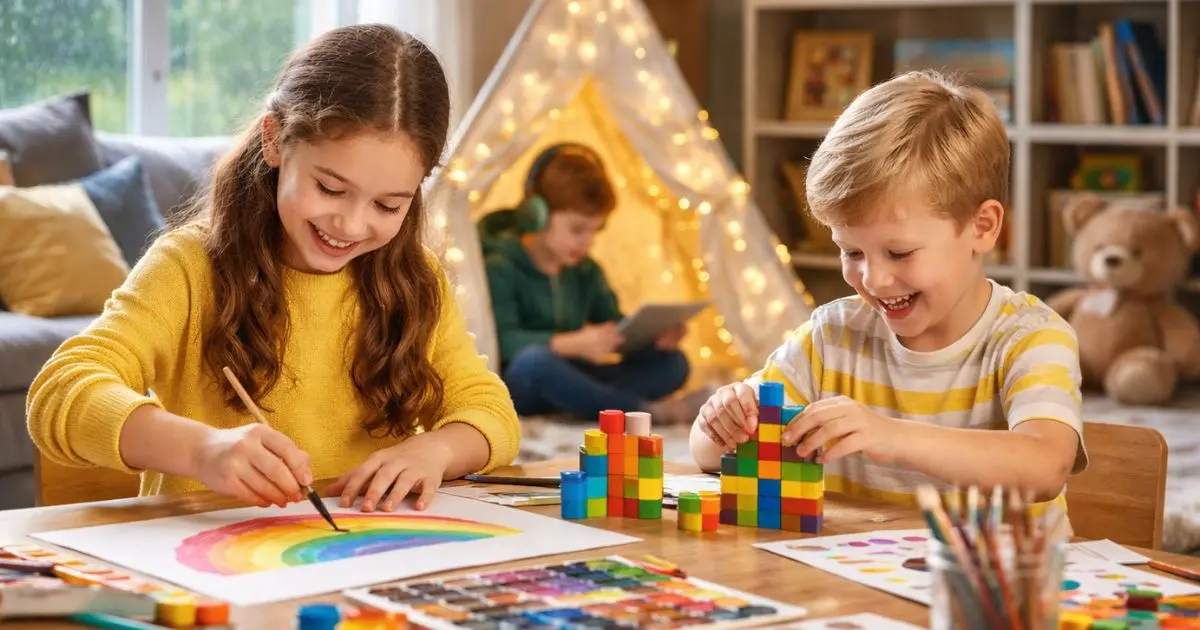
Rainy days can present a real challenge for parents, especially when your kids are full of energy but stuck indoors. Whether you’re dealing with toddlers, school-aged children, or even teens, keeping kids entertained on rainy days can feel like an overwhelming task. The challenge often comes from the need to find engaging indoor activities for kids that not only keep them busy but also encourage creativity, learning, and physical activity.
As a parent, it’s essential to find fun ways to prevent your child from feeling bored or frustrated while stuck inside. Rather than resorting to too much screen time or letting the day pass in a haze of inactivity, it’s important to have a variety of creative indoor activities on hand to keep them entertained and active.
In this article, we’ll explore a range of indoor play ideas for kids that will help burn off energy, promote physical development, and stimulate cognitive skills—all while fostering a positive and engaging environment during those rainy days. By the end, you’ll have a toolkit of fun, interactive, and educational activities to turn a gloomy day into an exciting adventure for your children!
The Rainy Day Struggle: Boredom & Screen Time Overload
Rainy days often bring about one universal issue: boredom. Kids with nowhere to expend their energy will inevitably start to feel frustrated, and as their frustration builds, so does the noise level. Without proper outlets, children are more likely to fall into unwanted behaviors, like tantrums, arguing, or over-indulging in screens.
Although screen time can be an easy go-to solution, it has its drawbacks, especially when overused. Too much screen time can lead to overstimulation, disrupt sleep, and even contribute to increased behavioral problems. This is why having a repertoire of creative, engaging indoor activities is so important for a child’s emotional regulation, creativity, and learning.
Let’s look at 10 expert-recommended indoor activities that will not only keep your children entertained but also promote their cognitive, emotional, and social development.
Indoor Activities for Kids on Rainy Days
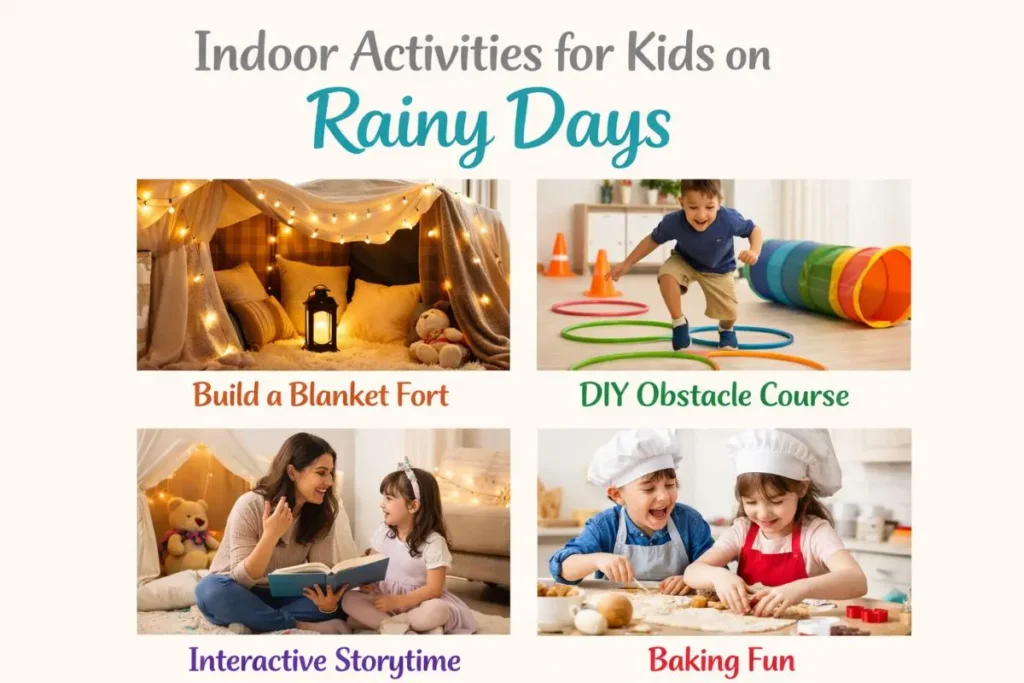
Build a Blanket Fort
Blanket forts are an age-old favorite. They allow kids to feel like they have their own space, while encouraging imaginative play, teamwork, and fine motor skills when setting up.
How to Do It:
- Collect pillows, blankets, and chairs.
- Create a cozy space with their favorite toys or books.
- Inside the fort, offer activities such as storytelling, reading, or even a small snack.
Educational Benefits:
- Encourages imagination and creative play.
- Improves problem-solving and collaboration (especially if siblings are involved).
- Helps children develop spatial awareness while arranging the fort.
DIY Obstacle Course
An indoor obstacle course is a fantastic way for kids to expend energy, build coordination, and work on gross motor skills.
How to Do It:
- Use pillows, chairs, and blankets to create tunnels, hurdles, and paths.
- Have your child complete the course as quickly as possible or with specific challenges (e.g., hopping on one foot or crawling under a table).
Educational Benefits:
- Builds physical strength, balance, and agility.
- Enhances following instructions and time management (if you time their runs).
- Boosts self-esteem through physical achievement.
Interactive Storytime
Storytime can become far more engaging when you make it interactive. Instead of simply reading aloud, act out the scenes with props and encourage your child to join in.
How to Do It:
- Choose a story that has clear characters and actions.
- Use toys, costumes, or household items as props to represent characters.
- Encourage your child to act out parts of the story or help tell it.
Educational Benefits:
- Develops language skills and story comprehension.
- Enhances empathy and role-play by stepping into different characters’ shoes.
- Improves listening and attention span.
Baking Fun
Baking not only provides a tasty treat but is also a wonderful way to teach your child about measurements, sequencing, and following instructions. Plus, it’s an excellent sensory experience!
How to Do It:
- Choose simple recipes like cookies, cupcakes, or brownies.
- Allow your child to help with measuring, stirring, and decorating.
- Create a “baking station” with everything they’ll need, and clean up together afterward.
Educational Benefits:
- Introduces basic math concepts (measurement, counting).
- Builds fine motor skills (mixing, decorating).
- Encourages following directions and patience.
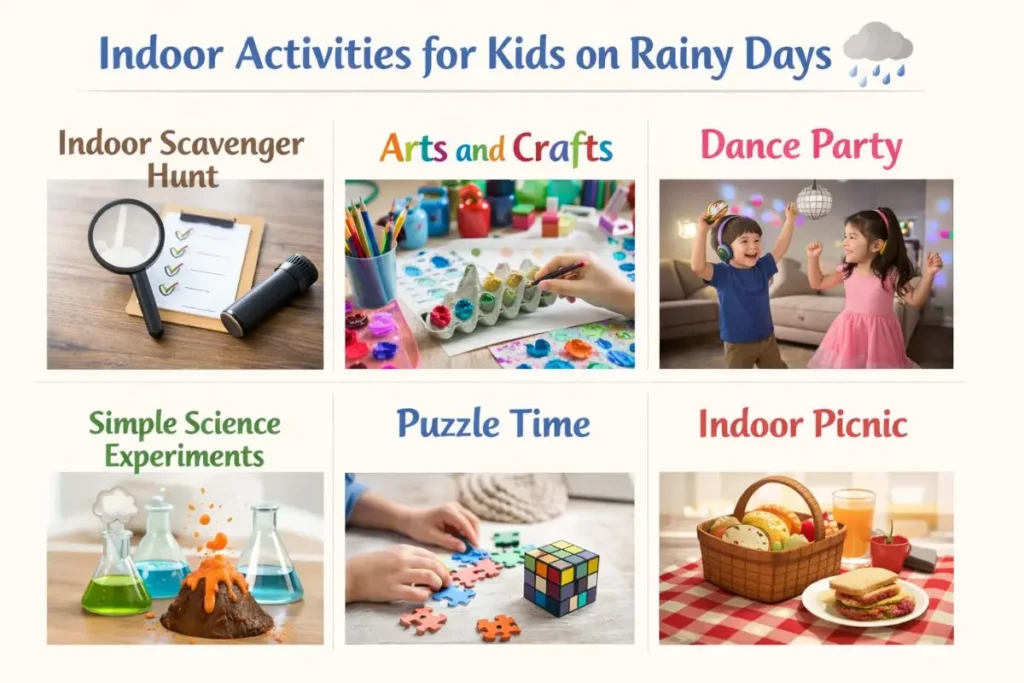
Indoor Scavenger Hunt
A scavenger hunt is not only fun but also a great way to keep kids moving, thinking critically, and exploring their environment.
How to Do It:
- Write clues or create a list of items for your child to find around the house.
- Add a bit of a challenge, such as riddles or specific characteristics (e.g., “find something red”).
- For older kids, include educational tasks such as identifying letters or solving simple math problems.
Educational Benefits:
- Encourages problem-solving, critical thinking, and teamwork.
- Promotes reading skills (if the clues are written) and following directions.
- Stimulates curiosity and exploration.
Arts and Crafts
Arts and crafts let kids explore their creativity while also enhancing fine motor skills. Whether painting, drawing, or crafting with paper, the possibilities are endless.
How to Do It:
- Set up an art station with crayons, markers, scissors, and paper.
- Let your child create anything they want, or guide them to make specific items like greeting cards or decorations.
- Display their creations proudly on the fridge or around the house.
Educational Benefits:
- Promotes creativity and self-expression.
- Enhances fine motor skills (cutting, coloring).
- Teaches patience and attention to detail.
Dance Party
Dancing is a fun, physical activity that helps kids burn off energy. It’s great for both physical exercise and mental well-being.
How to Do It:
- Put on some upbeat music.
- Dance with your child or have a “dance-off” with sibling teams.
- Incorporate dance challenges, such as freeze-dance, or make it a game where they copy your moves.
Educational Benefits:
- Promotes physical activity and coordination.
- Builds rhythm, balance, and muscle control.
- Boosts mood and self-confidence.
Simple Science Experiments
Science experiments are an excellent way to teach kids basic scientific concepts through hands-on activities. Simple experiments like making slime or creating a baking soda volcano are always a hit.
How to Do It:
- Choose easy experiments with household items (e.g., baking soda and vinegar for a volcano).
- Guide your child through the experiment, explaining the science behind it.
- Let them ask questions and hypothesize the results.
Educational Benefits:
- Introduces basic scientific concepts (cause and effect, chemical reactions).
- Encourages curiosity and critical thinking.
- Fosters problem-solving skills.
Puzzle Time
Puzzles are not just for quiet time; they are a fantastic way to boost cognitive development and concentration.
How to Do It:
- Select a puzzle that is appropriate for your child’s age and interests.
- Work on the puzzle together or make it a race to see who can complete theirs faster.
- Offer encouragement and celebrate small successes along the way.
Educational Benefits:
- Enhances cognitive development, spatial reasoning, and problem-solving.
- Develops attention to detail and concentration.
- Encourages teamwork and patience.
Indoor Picnic
Transform lunchtime into an adventure with an indoor picnic. It’s a fun way to break the routine and make mealtime exciting.
How to Do It:
- Spread a picnic blanket in the living room or your child’s play area.
- Pack your child’s favorite snacks or a lunch they can help prepare.
- Add extra fun by telling stories or playing a game during the picnic.
Educational Benefits:
- Promotes independence as kids help prepare their food.
- Encourages social skills if you include siblings or parents.
- Fosters a love for family meals and socializing.
Safety Tips
When planning indoor activities, ensure that your home is childproofed and safe. Avoid small objects that could be a choking hazard, keep cleaning supplies and sharp objects out of reach, and supervise children during crafts or when using scissors.
Safety Reminders:
- Check for sharp objects or potential dangers in play areas.
- Use non-toxic materials for crafts.
- Keep small objects (e.g., beads, buttons) away from younger children.
- Always supervise during physical activities.
How to Personalize Activities for Different Age Groups
Each age group has different developmental needs, so it’s essential to tailor activities to your child’s age.
Toddlers (1-3 years)
- Simple puzzles, building blocks, and sensory activities (e.g., water play, finger painting).
- Focus on fine motor skills and cause-and-effect activities.
Preschoolers (3-5 years)
- Imaginative play, arts and crafts, and obstacle courses.
- Encourage language development and social skills through group activities.
School-Aged Children (6-12 years)
- DIY science experiments, scavenger hunts, and team-building games.
- Provide opportunities for problem-solving and independent thinking.
Teens (13+ years)
- Creative writing, video making, or crafting.
- Encourage self-expression and independent learning.