
Understanding and expressing emotions can be challenging for children, especially as they’re still learning how to recognize and communicate their feelings. As a parent, your role is critical in helping them navigate their emotions, develop emotional intelligence, and build healthy coping mechanisms. This guide will provide you with age-specific strategies to help your child understand and talk about their feelings in a constructive way. Whether you’re dealing with toddler tantrums or teenage mood swings, these practical steps will make a real difference in your child’s emotional development.
Core Pain Point: Helping Kids Express and Manage Their Emotions
For many parents, one of the most frustrating aspects of raising a child is seeing them struggle with expressing their feelings. From tantrums in toddlers to emotional withdrawal in teens, emotions are a normal, albeit sometimes overwhelming, part of growing up. The goal here is to equip you with the tools you need to support your child through these emotional challenges, ensuring they understand their feelings and learn to express them in healthy ways.
Talk to Kids About Feelings Age by Age
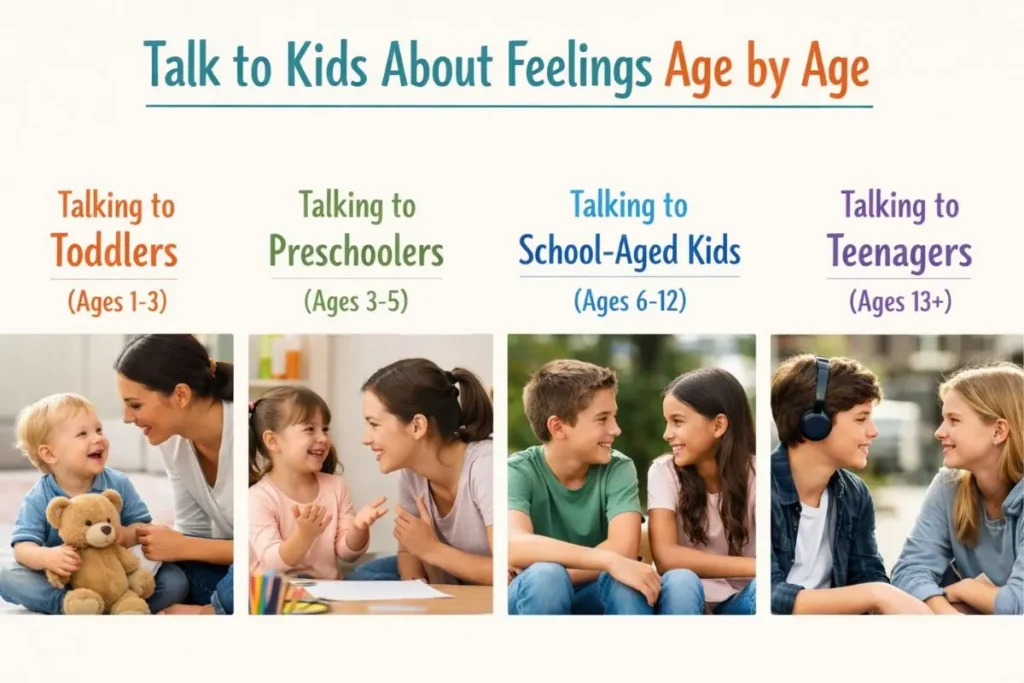
Talking to Toddlers (Ages 1-3)
Toddlers are just beginning to develop emotional awareness but often lack the vocabulary to articulate their feelings. They might express frustration through tantrums, crying, or aggressive behavior because they don’t yet know how to manage their emotions.
Key Strategies:
- Label Emotions for Them
- Since toddlers are still developing their emotional vocabulary, it’s helpful to name the emotions they’re experiencing. For example:
- “It looks like you’re angry because it’s time to go home from the park.”
- “You’re feeling sad because you can’t play with that toy right now.”
- This helps toddlers connect the word with the emotion and understand what they’re feeling.
- Since toddlers are still developing their emotional vocabulary, it’s helpful to name the emotions they’re experiencing. For example:
- Model Emotional Expressions
- Children learn by imitation. Express your own emotions clearly and calmly. For example:
- “I’m feeling frustrated because I can’t find my keys.”
- “I’m happy because it’s a beautiful day!”
- When they see you identifying and expressing emotions, they’ll be more likely to do the same.
- Children learn by imitation. Express your own emotions clearly and calmly. For example:
- Provide Comfort and Reassurance
- Toddlers often need reassurance that their emotions are valid. When they experience frustration or sadness, comfort them:
- “It’s okay to feel upset. Let’s take a deep breath together.”
- “I know you’re mad. Let’s figure out what we can do.”
- Toddlers often need reassurance that their emotions are valid. When they experience frustration or sadness, comfort them:
- Create a Calm-Down Routine
- Introduce a calming routine for when emotions get overwhelming. Deep breathing, counting, or even a short time-out in a quiet space can help a toddler calm down.
Talking to Preschoolers (Ages 3-5)
Preschoolers are better at recognizing their emotions, but they still need help understanding what those emotions mean. At this age, they are also beginning to experience a wider range of feelings, from joy to frustration and even shame.
Key Strategies:
- Use Feelings Charts and Visual Aids
- A feelings chart with images depicting different emotions can help preschoolers identify what they’re feeling. You can ask them:
- “Can you show me the face of how you’re feeling today?”
- “Are you feeling happy, sad, or angry?”
- These visual tools help kids make connections between words and emotions.
- A feelings chart with images depicting different emotions can help preschoolers identify what they’re feeling. You can ask them:
- Encourage Expressive Play
- Preschoolers love pretend play, and it’s a great opportunity to help them understand and express their emotions. Use dolls or action figures to act out different emotional scenarios.
- “Let’s pretend the doll is sad because she lost her favorite toy. What could she do to feel better?”
- Preschoolers love pretend play, and it’s a great opportunity to help them understand and express their emotions. Use dolls or action figures to act out different emotional scenarios.
- Ask Reflective Questions
- Help your preschooler reflect on their emotions by asking simple questions:
- “How did you feel when your friend didn’t share with you?”
- “What made you feel happy today?”
- Help your preschooler reflect on their emotions by asking simple questions:
- Promote Problem-Solving
- After helping them label their emotions, guide them to think about how to solve emotional challenges. For instance:
- “You’re upset because you can’t play with the toy right now. What could we do instead?”
- After helping them label their emotions, guide them to think about how to solve emotional challenges. For instance:
Talking to School-Aged Kids (Ages 6-12)
At this stage, children have a better grasp of their emotions but are still learning how to deal with them effectively. They begin to face more complex emotions related to friendships, academic stress, and self-esteem.
Key Strategies:
- Expand Their Emotional Vocabulary
- Teach your child words beyond the basics, such as “disappointed,” “frustrated,” or “embarrassed.” This will help them better articulate what they’re feeling.
- “It sounds like you’re feeling frustrated because you can’t find your homework.”
- Teach your child words beyond the basics, such as “disappointed,” “frustrated,” or “embarrassed.” This will help them better articulate what they’re feeling.
- Create an Emotional “Check-In” Routine
- Have a regular “check-in” where you ask your child about their feelings. This can be a nightly routine or a part of dinnertime conversation:
- “What made you feel proud today?”
- “Was there anything that made you feel nervous?”
- Have a regular “check-in” where you ask your child about their feelings. This can be a nightly routine or a part of dinnertime conversation:
- Validate Their Feelings
- At this age, children are highly sensitive to how others react to their emotions. Always validate their feelings, even if you don’t fully understand why they feel that way.
- “It’s okay to feel nervous about the test. A lot of kids feel that way before a big exam.”
- “I understand why you’re upset about your friend. It’s hard when someone we care about isn’t kind.”
- At this age, children are highly sensitive to how others react to their emotions. Always validate their feelings, even if you don’t fully understand why they feel that way.
- Use Real-Life Examples
- Help them relate their emotions to real-life examples, such as how you might handle a similar situation. This teaches them that emotions are natural and manageable.
- “When I’m stressed at work, I like to take a short walk or listen to music. What do you think would help you feel better?”
- Help them relate their emotions to real-life examples, such as how you might handle a similar situation. This teaches them that emotions are natural and manageable.
Talking to Teenagers (Ages 13+)
Teenagers are dealing with an intense combination of hormonal changes, peer pressures, and developing independence. It can be challenging to engage them in conversations about emotions, but it’s crucial for their emotional growth.
Key Strategies:
- Create a Safe and Open Environment
- Teens often feel misunderstood, so it’s vital to ensure they feel heard and not judged. Allow them to express their feelings without immediately offering solutions.
- “I’m here if you want to talk, but I won’t push you. Take your time.”
- Teens often feel misunderstood, so it’s vital to ensure they feel heard and not judged. Allow them to express their feelings without immediately offering solutions.
- Ask Open-Ended Questions
- Rather than asking yes/no questions, encourage your teen to explore their feelings with open-ended questions:
- “What made you feel really proud this week?”
- “How did you handle that difficult situation with your friends?”
- Rather than asking yes/no questions, encourage your teen to explore their feelings with open-ended questions:
- Be Supportive, Not Controlling
- Teens are learning how to make decisions independently, and it’s important to provide guidance without controlling them. Instead of offering direct solutions, guide them to find their own answers.
- “What do you think would help you feel more confident during your presentation?”
- Teens are learning how to make decisions independently, and it’s important to provide guidance without controlling them. Instead of offering direct solutions, guide them to find their own answers.
- Use Examples from Their World
- Teens respond well to examples they can relate to. Use stories from pop culture or current events to discuss emotions and help them understand that everyone goes through similar experiences.
Common Mistakes
Parents often make a few common mistakes when discussing feelings with their kids. Here’s what to watch out for and how to avoid these pitfalls:
| Mistake | Solution |
|---|---|
| Minimizing Emotions | Instead of saying “It’s not a big deal,” acknowledge the emotion. E.g., “I see this is upsetting for you.” |
| Overreacting | Stay calm and composed. Reacting emotionally teaches kids that emotions are something to fear. |
| Dismissing Their Need to Talk | Always encourage your child to talk, even if it seems trivial. Foster open communication by being available. |
| Offering Solutions Too Quickly | Let them express their feelings first. Once they’ve shared, guide them to find solutions, rather than immediately offering advice. |