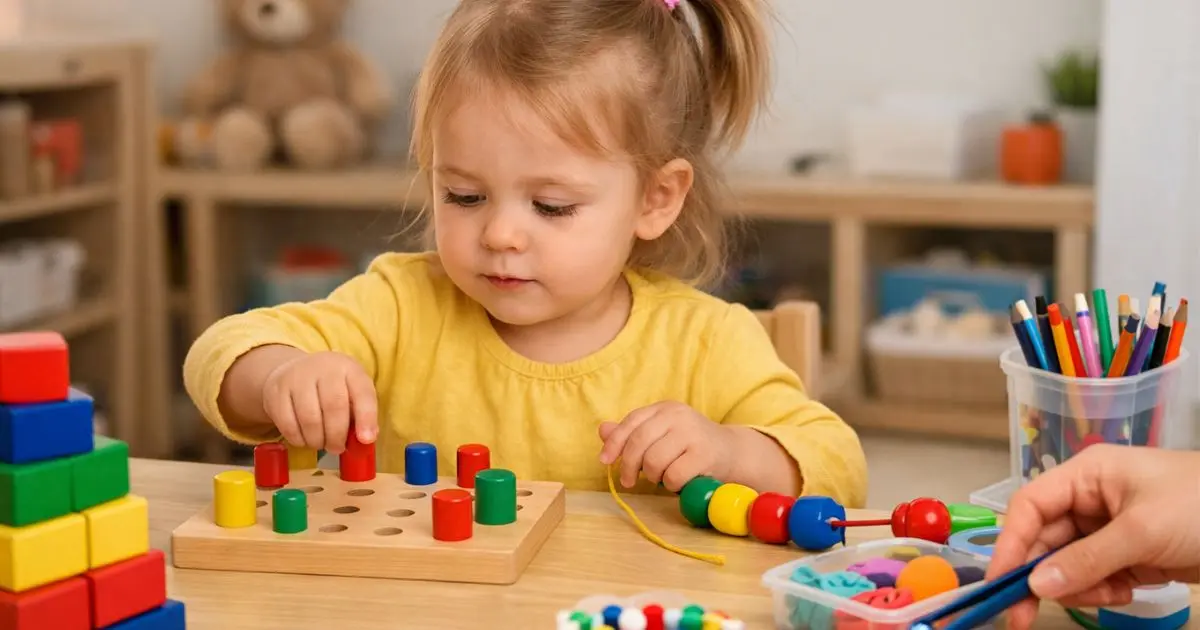
“How to help toddlers develop fine motor skills is a common question for parents and caregivers, as fine motor development is crucial for a child’s overall growth. Fine motor skills involve the small muscles in the hands, fingers, and wrists, and they are essential for activities such as gripping a pencil, buttoning clothes, or feeding themselves.
These skills play an important role in fostering independence and confidence in toddlers. Understanding how to help toddlers develop fine motor skills early on can significantly impact their ability to perform everyday tasks. Through engaging activities, games, and exercises, you can support your toddler in mastering the hand-eye coordination and muscle control necessary for fine motor development.”
What Are Fine Motor Skills?
Fine motor skills refer to the small movements of the hands, fingers, and wrists. These skills are necessary for tasks that require precision and control. Fine motor skills are vital in early childhood development and play a crucial role in toddlers’ ability to interact with their world.
Movements Involved in Fine Motor Skills:
- Grasping: Holding small objects like a spoon, toy, or crayon.
- Manipulating: Moving objects such as stacking blocks or fitting shapes into a sorter.
- Coordination: Using both hands together for tasks like drawing or turning a page.
Why Are Fine Motor Skills Important for Toddlers?
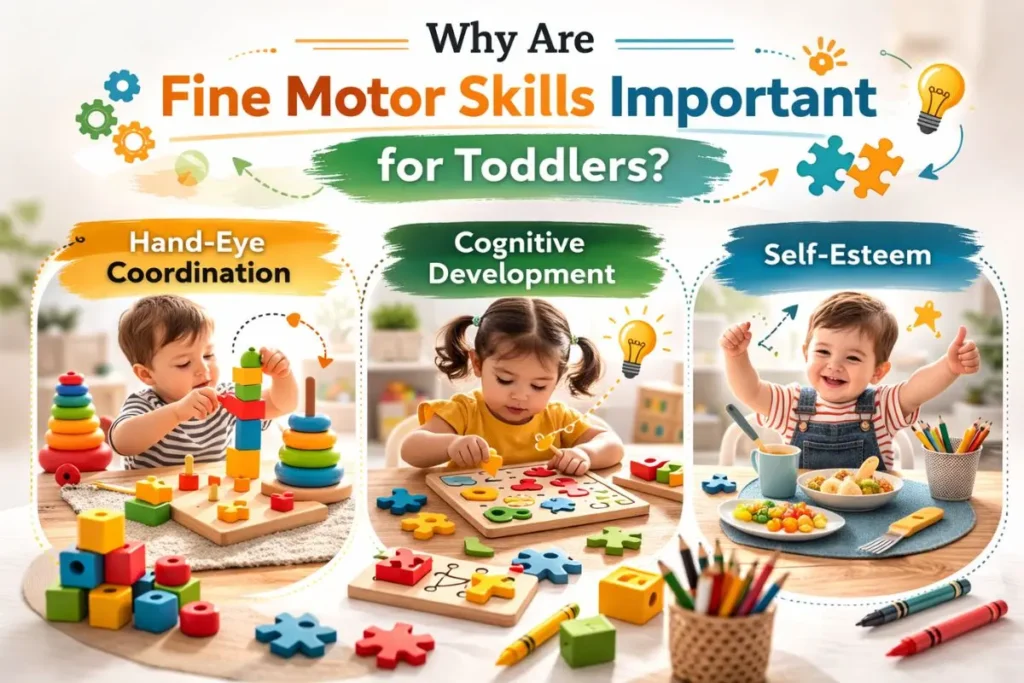
Fine motor skills are not just about hand-eye coordination—they also influence a child’s cognitive abilities, language development, and independence. Mastering these skills helps toddlers perform everyday tasks and prepares them for more complex activities as they grow.
Benefits :
- Hand-Eye Coordination: Toddlers learn how to use their eyes and hands together, which is crucial for tasks like reading or writing.
- Cognitive Development: Fine motor skills are linked to a toddler’s ability to think, solve problems, and learn new concepts.
- Self-Esteem: When toddlers learn to do things on their own, they feel a sense of accomplishment, which boosts their confidence.
How To Develop Fine Motor Skills
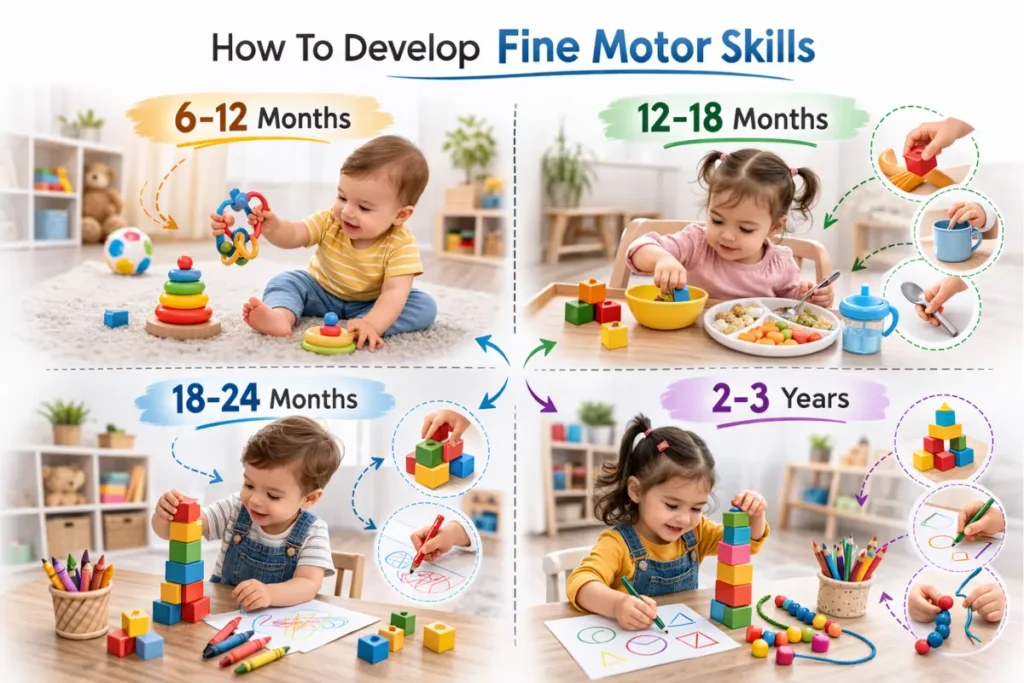
6-12 Months
At this stage, your toddler is learning how to use their hands with more control. They will begin to grasp objects, reach for toys, and transfer objects from one hand to another, showing early signs of hand-eye coordination and dexterity.
- What to Look For:
- Grasping toys like rattles or small objects.
- Reaching for items to explore.
- Transferring objects from one hand to the other.
- Developmental Importance:
These milestones show that your toddler is gaining control over their hand movements, which will later support more complex actions like feeding themselves or playing with puzzles.
12-18 Months
By this age, toddlers are refining their grasping abilities. They will start picking up small objects with a pincer grasp (using their thumb and forefinger) and begin feeding themselves, though they may still need help.
- What to Look For:
- Picking up small items like blocks or food.
- Feeding themselves with fingers or a spoon.
- Using a cup with some assistance.
- Developmental Importance:
This is an important stage for independence. As toddlers learn to feed themselves and handle small objects, they develop a sense of autonomy and build confidence in their abilities.
18-24 Months
At this stage, toddlers are more precise with their hand movements. They begin to use a spoon with increasing independence, stack blocks, and engage in scribbling with crayons.
- What to Look For:
- Using a spoon to feed themselves (with some help).
- Stacking two or three blocks.
- Drawing with crayons, starting to make lines or shapes.
- Developmental Importance:
These activities are great signs of improved hand-eye coordination, grip strength, and dexterity. Scribbling marks the start of creativity, while stacking blocks shows growing problem-solving skills.
2-3 Years
By age 2 to 3, toddlers gain more control over their fine motor skills. They can build towers with blocks, draw simple shapes, and string large beads. These activities require more manual dexterity and coordination.
What to Look For:
Building towers with 3-4 blocks.
Drawing simple shapes like circles or lines.
Stringing large beads onto a cord.
Developmental Importance:
These milestones indicate higher precision in movements. The ability to build, draw, and string beads also reflects cognitive skills like spatial awareness and pattern recognition, which are important for later learning and development.
Fun and Easy Activities
Incorporating fine motor skill activities into everyday play is a great way to support your toddler’s development. Here are several fun and simple activities that encourage fine motor skill growth.
Play with Playdough and Clay
Playdough is an excellent tool for developing fine motor skills. When toddlers roll, flatten, and mold playdough, they work on their hand muscles and coordination.
- Activity Ideas:
- Roll the dough into snakes or balls.
- Use cookie cutters to make shapes.
- Press down on the dough to make impressions.
These activities improve both grip strength and hand-eye coordination.
Puzzles and Shape Sorters
Puzzles and shape sorters help toddlers practice grasping, sorting, and fitting shapes together. These tasks are excellent for improving problem-solving skills and coordination.
- Activity Ideas:
- Let your toddler try fitting pieces into the correct places in a puzzle.
- Use shape sorters to help them learn how to match shapes with corresponding holes.
These activities help toddlers improve cognitive development alongside fine motor skills.
Finger Painting and Drawing
Painting with fingers or crayons helps toddlers improve their control over fine hand movements. These activities also stimulate creativity.
- Activity Ideas:
- Try finger painting using safe, non-toxic paints.
- Provide large crayons and encourage your toddler to draw shapes like circles and lines.
This type of play encourages hand strength and builds confidence as toddlers create their own art.
Building with Blocks and Legos
Building toys, like blocks or Legos, help toddlers develop dexterity and coordination. These toys also improve spatial awareness as toddlers figure out how to stack or build objects.
- Activity Ideas:
- Start by building simple towers and let your toddler knock them down.
- Encourage them to build structures like houses or bridges.
Building activities foster problem-solving skills and fine motor control.
Simple Household Tasks
Household chores can become fun and educational! Everyday tasks provide opportunities for toddlers to use their fine motor skills.
- Activity Ideas:
- Let your toddler help fold towels or sort laundry.
- Encourage them to pick up toys or put away books.
These tasks help toddlers practice grasping, sorting, and placing—all essential fine motor skills.
How to Make Fine Motor Skill Development Fun
Toddlers learn best through play, so it’s important to make fine motor skill development feel like a fun experience. Here are some ideas to make the process enjoyable:
- Incorporate toys that are both fun and educational, like activity centers, stacking cups, or shape sorters.
- Turn everyday activities into fine motor exercises, such as helping to set the table or feeding a pet.
- Join in the fun! Toddlers love it when you play along, so build with them, color together, or create art.
By integrating fine motor skill activities into daily life, you can make learning enjoyable and part of your toddler’s routine.
When to Seek Professional Help
If your toddler is not showing signs of developing fine motor skills or struggling significantly with everyday tasks, it may be helpful to consult a professional. Early intervention can be critical if your child has developmental delays.
Signs That Professional Help May Be Needed:
- Difficulty grasping small objects or using a spoon by age 3.
- Inability to complete basic tasks like stacking blocks or drawing simple shapes.
- Uncoordinated movements that seem out of the ordinary.
If these concerns arise, speaking with a pediatrician or occupational therapist can provide guidance and support for your toddler’s development.
Tips for Encouraging
In addition to play, here are some tips that can encourage the development of fine motor skills:
- Provide a variety of textures: Let your toddler explore different textures like sand, fabric, or water to develop their tactile senses.
- Offer small tools: Scissors, tweezers, or tongs are excellent for building hand strength and control.
- Give them time to practice independently: Allow your toddler to try dressing themselves or use utensils during meals.
Fine Motor Skill Development and Playtime
Playtime is essential for toddlers as it not only supports fine motor skill development but also promotes cognitive and emotional growth. By encouraging both structured and free play, toddlers learn to use their hands in creative and functional ways.
How Play Enhances Development:
- Physical: Play helps improve muscle strength and coordination.
- Cognitive: Toddlers use problem-solving skills while playing with toys.
- Emotional: Play fosters creativity and builds self-esteem.