
As a parent, it can be incredibly distressing when your newborn experiences discomfort from gas and colic. These common issues often lead to excessive crying, causing both the baby and parents to feel exhausted and overwhelmed. Learning how to soothe gas and colic in newborns is crucial for providing relief and ensuring both your baby and you can get the rest you need.
Gas discomfort in newborns is usually caused by swallowed air during feeding, while colic can result in prolonged periods of crying due to digestive upset or an immature digestive system. Fortunately, there are many proven remedies and techniques to ease your newborn’s discomfort and help restore peace in your household.
Why Gas and Colic Are Common in Newborns
Gas and colic are two conditions that often go hand-in-hand during the early months of life. Newborns’ digestive systems are still developing, and they can easily become gassy. Additionally, babies often swallow air while feeding, leading to discomfort. Colic, on the other hand, is a condition that causes excessive crying and fussiness, with no clear medical cause.
These issues typically appear when babies are around 2–3 weeks old, and while they are common, it can still be stressful for both parents and babies. Understanding why these problems occur can help you feel more in control and prepared to help soothe your baby.
How Long Do Last in Newborns?
For many babies, gas and colic can last until they are around 3–4 months old. The good news is that the intensity of the symptoms usually decreases over time as their digestive systems mature. However, each baby is different, and some may outgrow it sooner than others.
If the discomfort is prolonged or particularly severe, it’s important to consult your pediatrician. But in most cases, gas and colic are phases that will pass as your baby’s digestive system continues to develop.
Understanding Gas and Colic
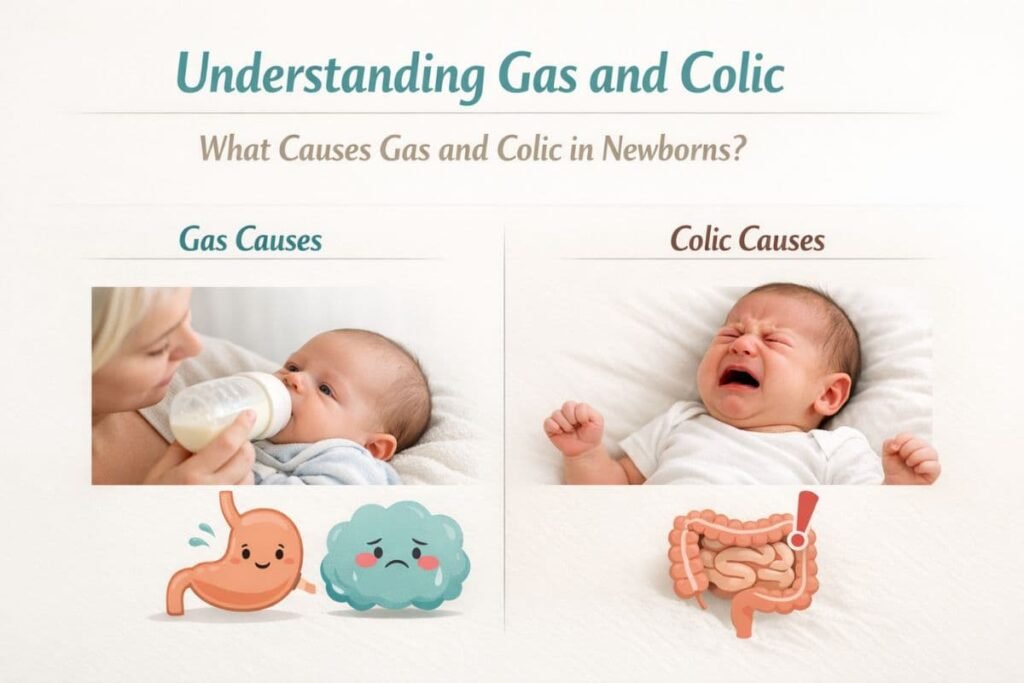
What Causes Gas and Colic in Newborns?
Gas and colic are common issues for newborns. However, they are not the same. Gas occurs when babies swallow air during feedings, which can cause bloating, discomfort, and excessive crying. On the other hand, colic is a term used to describe long periods of intense crying, typically occurring in healthy babies under three months. It is believed that colic is often caused by an immature digestive system that is still adjusting to life outside the womb.
Gas Causes:
- Swallowing air during feedings
- Immature digestive system
- Poor latch during breastfeeding
Colic Causes:
- Digestive system development
- Unresolved discomfort
- Possible sensitivity to milk or formula
Signs Your Newborn May Have
It can be tricky to tell whether your baby is dealing with gas or colic, but there are distinct signs that can help.
- Gas Symptoms:
- Crying and fussiness immediately after feedings.
- Pulling their legs toward their belly.
- A hard or bloated tummy.
- Colic Symptoms:
- Intense crying episodes, often in the late afternoon or evening.
- Crying that lasts for more than three hours a day.
- A baby who is otherwise healthy but appears to be in pain.
If your baby is displaying these signs, they may be struggling with either gas pain or colic discomfort.
How to Soothe Gas in Newborns
Burp Your Baby After Every Feeding
Burping your baby is essential to release trapped air that causes gas. Babies swallow air when feeding, especially if they are very hungry or drinking too quickly. Burping helps reduce gas and can provide quick relief.
- Tips for Burping:
- Hold your baby upright for 10–15 minutes after each feeding.
- Gently pat or rub their back in an upward motion.
- Try burping every 2–3 ounces if bottle-feeding.
Burping is one of the easiest and most effective ways to prevent gas buildup in your newborn.
Gently Massage Your Baby’s Belly
A gentle belly massage can ease gas discomfort by helping the digestive system work more efficiently. By massaging the tummy, you help release trapped gas and provide soothing comfort.
- How to Massage:
- Use gentle circular motions on your baby’s tummy.
- Apply natural oils like olive oil or coconut oil to reduce friction.
- Be sure to keep your touch light, as your baby’s stomach is very sensitive.
Massaging your baby’s tummy is not only a way to relieve gas pain, but also a bonding experience.
Hold Your Baby in a Colic Hold
The colic hold can be very effective in easing both gas and colic discomfort. This position helps to release pressure on the baby’s tummy and can often calm them down quickly.
- How to Do the Colic Hold:
- Hold your baby across your forearm, with their tummy facing down.
- Gently rock or sway while supporting their head and neck.
- You can also try walking around or bouncing lightly to help with soothing.
The colic hold mimics the fetal position, which can be comforting and relieve gas pressure.
Use a Warm Compress
A warm compress can soothe a gassy tummy by helping relax the muscles in your baby’s abdomen. The warmth mimics the comfort of the womb and can provide relief from bloating.
- How to Use a Warm Compress:
- Place a warm (not hot) towel or cloth on your baby’s tummy.
- Leave it on for 5-10 minutes, ensuring it’s not too hot.
- You can also use a baby-safe heating pad set on low heat.
This simple trick can make a big difference in your baby’s comfort level.
How to Soothe Colic in Newborns

Try a Baby-Approved Probiotic
Probiotics are beneficial bacteria that can help your baby’s digestive system function more effectively. Studies have shown that probiotics can reduce symptoms of colic by promoting healthy gut bacteria.
- Probiotic Options:
- Probiotic drops specifically designed for infants.
- Consult your pediatrician to ensure you’re using a product appropriate for your baby.
Using probiotics for colic has been shown to improve digestion and reduce crying episodes.
Create a Calming Environment
Colic can be aggravated by overstimulation, so creating a calming environment for your baby can help. Colicky babies often respond well to a quiet, soothing atmosphere.
- Tips to Calm Your Baby’s Environment:
- Dim the lights and reduce background noise.
- Use white noise machines or soft lullabies.
- Keep the room at a comfortable temperature.
A calming environment can significantly reduce the frequency of colic episodes and help your baby feel more relaxed.
Use Colic-Relief Gripe Water or Gas Drops
Gripe water and gas drops are widely used for treating colic and gas in newborns. These remedies can help alleviate gas pain and soothe your baby’s stomach.
- How to Use Gripe Water:
- Follow the dosage instructions on the label.
- Administer after feedings to prevent or treat colic.
Gripe water contains ingredients like ginger and fennel, which have been shown to reduce discomfort and ease digestion.
Offer a Pacifier or Suckling
Sucking on a pacifier or breastfeeding can help calm a colicky baby. The act of sucking has a soothing effect and can help release tension in your baby’s body.
- If breastfeeding, allow your baby to nurse for comfort.
- Offer a pacifier if your baby isn’t breastfeeding.
Suckling can be especially helpful if your baby is crying inconsolably, as it can help distract them from discomfort.
When to Consult Your Pediatrician
When Might Be Something More Serious
Although gas and colic are common and often resolve with time, there are occasions when the symptoms could indicate something more serious, such as gastroesophageal reflux disease (GERD) or a milk allergy.
- When to See a Doctor:
- If your baby’s crying is excessively prolonged and nothing helps.
- If your baby seems to be in more pain than usual, even with soothing techniques.
- If your baby is not feeding properly or is losing weight.
A pediatrician can help rule out any other causes and offer further guidance or treatment.
Common Myths
There are many misconceptions about gas and colic in newborns. Parents are often misled by myths that can add to their stress. Let’s take a look at a few of the most common myths:
- Myth 1: Colic is caused by something the parents did wrong.
- Fact: Colic is not the result of anything parents did wrong; it’s a natural phase in many babies’ development.
- Myth 2: Colic can be completely cured with medication.
- Fact: There is no “cure” for colic, but the symptoms can be managed with probiotics, soothing techniques, and time.